Onboarding Email Examples — how brands move new subscribers to first action
Every onboarding send from every brand we track. Sequences, hooks, activation patterns — on the record.
Onboarding emails do one thing welcomes don't: they drive the subscriber from signup to a meaningful first action. The activation moment. Time-to-value. Whatever your team calls it. The collection below pulls every onboarding email indexed in the BadRep vault — classified by sequence step, hook type, copy framework, ESP, and funnel stage. We surface what brands actually send.
What brands actually do.
Most-used hook types
- 01Direct Offer44%
- 02Question16%
- 03Problem13%
- 04Curiosity9%
- 05Bold Claim8%
Most-used copy frameworks
- 01AIDA23%
- 02Other19%
- 03Story-led18%
- 04FAB13%
- 05Feature-led10%
5 rules for onboarding emails that convert.
What actually works — pulled from analyzing real send data, not from generic copywriting blog posts.
Define your activation moment first
Before you write a single onboarding email, name the activation event explicitly. For SaaS, it's usually a specific in-product action. For DTC, it's first purchase. For habit-change apps, it's day-three completion. The onboarding sequence's only job is to drive that specific event.
Use behavior-based triggers, not time-based
Time-based sequences ('day 1, day 3, day 7') ignore what the subscriber has actually done. Behavior-based onboarding adapts — if the user already completed the activation event, skip ahead. If they're stuck on step 2, address that specifically. Modern ESPs make this trivial.
Front-load the easiest win
The first onboarding email should drive the lowest-friction action that delivers a real outcome. Not 'complete your profile.' Not 'invite your team.' Something the subscriber can do in 60 seconds and feel an immediate result.
Address objections, not just features
Strong onboarding sequences anticipate the moments where subscribers drop off — pricing concerns at day 3, integration questions at day 7, time-commitment fears at day 14. Each email addresses one specific objection, not a generic feature tour.
Track engagement and adjust the cadence
Subscribers who open every email get a tighter cadence. Subscribers who haven't opened in a week get a re-engagement breakpoint or a sequence pause. The strongest onboarding programs adapt to engagement, not just time.
How to write a onboarding email — step by step.
- Step 01
Pick the activation moment
What single in-product action signals the subscriber 'got it'? That's your target. Everything in the sequence works backward from there.
- Step 02
Map the 3–5 micro-actions that lead there
Activation rarely happens in one step. Break it down: signup → first login → first action → repeat action → activation. Each micro-action gets one email in the sequence.
- Step 03
Write each email to drive one specific click
One email = one CTA = one micro-action. The pattern repeats: headline naming the result, brief context, one button.
- Step 04
Set up behavior-based branching
If the subscriber completes a micro-action, skip to the next. If they don't, send a 'stuck?' email. This branching is what separates good onboarding from great.
- Step 05
Define the sequence end and the handoff
After 14–21 days, the onboarding sequence ends. The subscriber moves to your regular lifecycle nurture. Write the explicit handoff email so they know what to expect next.
The latest onboarding from across the catalog.
Real sends, recent dates, real subject lines. Click any thumbnail to see the full email inside the vault.


Mistakes brands keep making with onboarding emails.
The patterns we see repeatedly across the catalog — the ones that quietly cap performance.
Feature tour disguised as onboarding
Walking a new user through every feature is not onboarding — it's overload. Strong onboarding picks one feature per email and ties it to a specific outcome.
Time-based sequence ignoring behavior
Sending day-7 'why aren't you using us yet?' to someone who logs in every day reads as broken. Behavior data should always override time triggers.
Onboarding that never ends
Sequences that drag past 14–21 days dilute into nurture. Define a clear sequence end and hand off to the regular lifecycle program.
Ignoring sign-up source
A subscriber from a content download has a different onboarding need than a subscriber from a free trial signup. Routing by source dramatically improves activation.
Subject lines we noticed, verbatim.
Six standout subject lines from six different brands in this sample. Real subject lines — these landed in inboxes.
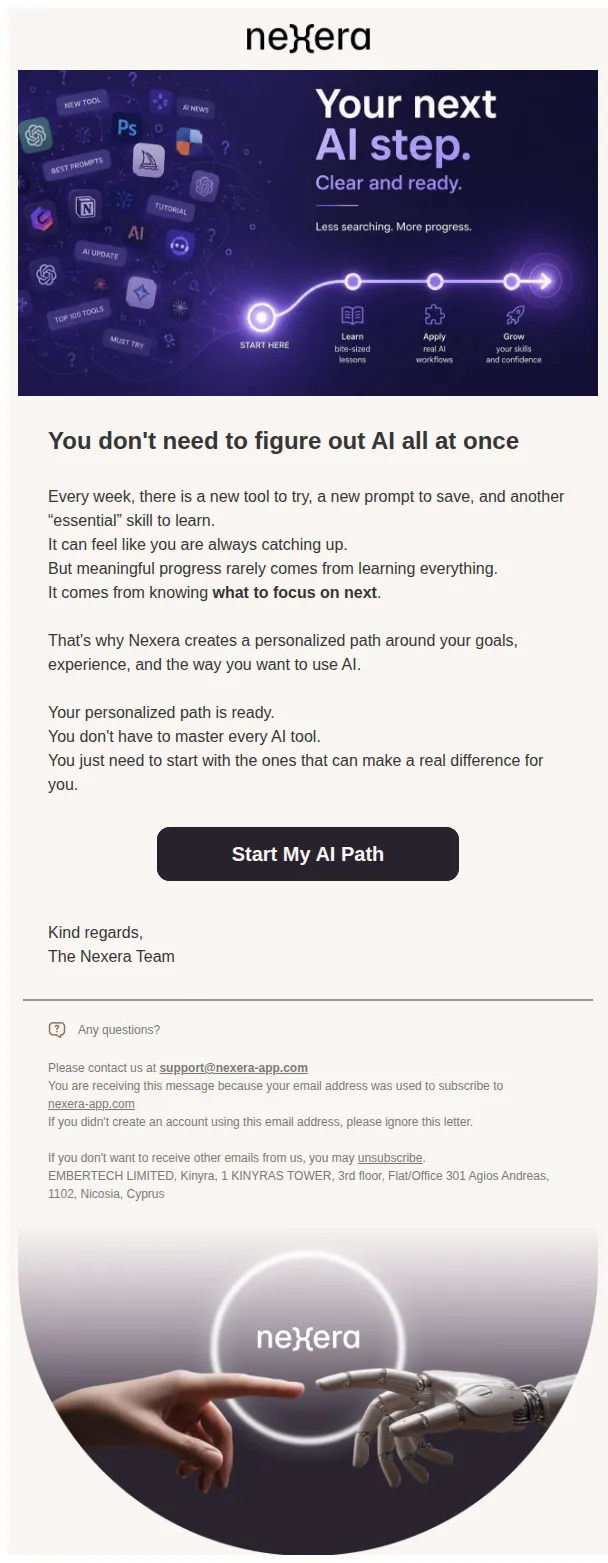
- 01Your next AI step is already mapped out
- 02CookUnity 101, and 50% off
- 03Name, your weight loss plan is almost ready
- 04Hey, better hearing starts here.
- 05We’ve analyzed your skin — here’s what needs support 🧴
- 06So… what is Good Inside?
Questions marketers ask.
What makes a good onboarding email?
What hook types do brands use for onboarding emails?
Which ESPs do brands use to send onboarding emails?
What's the average subject line length for onboarding emails?
Where can I see more onboarding email examples?
600+ brands. 20,000+ classified emails.
Inside the vault.
Filter by hook, framework, ESP, funnel stage — search every send. $19/mo. Cancel anytime.
Browse the vault — free