Abandoned Cart Email Examples — how brands actually recover lost revenue
Every abandoned cart send from every brand we track. Subject lines, timing, offer patterns — on the record.
Abandoned cart recovery is the highest-leverage automation in any e-commerce or subscription program. Done well, it recovers single-digit-percent of carts at near-zero incremental cost. Done badly, it discounts your full-price buyers and trains them to wait. The collection below pulls every abandoned cart email indexed in the BadRep vault — classified by hook type, copy framework, ESP, send-time delay, and offer mechanic. We surface what brands actually do, not what best-practice posts say they should do.
What brands actually do.
Most-used hook types
- 01Bold Claim40%
- 02Problem21%
- 03Direct Offer16%
- 04Curiosity11%
- 05Question6%
Most-used copy frameworks
- 01BAB37%
- 02PAS28%
- 03AIDA14%
- 04FAB11%
- 05Other5%
6 rules for abandoned cart emails that convert.
What actually works — pulled from analyzing real send data, not from generic copywriting blog posts.
Send the first reminder within 1–4 hours
The fastest sequences outperform the deliberate ones. Industry data and our own DB consistently show the first reminder belongs within 1–4 hours of cart abandonment, while the intent is still warm. Brands that wait 24 hours for the first send leave ~30% of recoverable revenue on the table.
Show the actual cart in the email
Dynamic product blocks — the exact items they left, with images, names, and prices — outperform generic 'you left something behind' messaging by a wide margin. Klaviyo, Iterable, and Braze all make this trivial. If your ESP can't pull cart contents into the email, that's a tooling problem worth fixing.
Lead with a no-discount reminder first
Don't open the discount gates on send one. Many shoppers were already going to convert — discounting them trains repeat buyers to abandon for the offer. The strongest sequences start with a no-friction reminder, then escalate to social proof on send two, and only introduce a discount on send three (if at all).
Address the actual objection
Carts are usually abandoned for three reasons: shipping cost, sizing/fit confidence, or buyer indecision. The best abandoned cart emails address one of these explicitly — 'free shipping included,' 'easy returns,' 'here's why X chose this style.' Generic 'come back' messaging answers a question nobody asked.
Use a 3-step sequence, not single-send
Single-send cart recoveries cap recoverable revenue at ~5%. Three-email sequences pushed out over 7–10 days double that. The sequence pattern that works: hour 1 reminder → day 1 social proof → day 3 incentive (if needed). Going past three sends rarely adds incremental revenue and starts to annoy.
Suppress recent buyers from the sequence
A surprisingly common bug: cart abandonment fires before the purchase event syncs, so customers who completed checkout get the 'you forgot something' email anyway. Adding a 30-minute delay before the first send (and re-checking purchase status before subsequent sends) eliminates this entirely.
How to write a abandoned cart email — step by step.
- Step 01
Identify the cart-abandonment trigger event in your ESP
Klaviyo, Iterable, Customer.io, Braze — each has a slightly different way to define 'cart abandoned.' Lock down the trigger logic before writing copy. The trigger usually fires when a user adds to cart, then leaves without checking out within X minutes. 30–60 minutes is the standard window.
- Step 02
Map your three-step sequence on paper
Send 1 (hour 1): reminder, no discount. Send 2 (day 1): social proof or objection-handling. Send 3 (day 3): incentive if needed. Write each in the order they'll arrive — what does the subscriber already know by send 3 that they didn't on send 1?
- Step 03
Write subject lines for the inbox preview, not the open
The first 30 characters carry the open. Subject lines like 'You left something behind' work because they fit in the mobile preview. Subject lines like 'A friendly reminder about your shopping cart from {Brand}' truncate to nothing.
- Step 04
Use dynamic product blocks for the cart contents
Every modern ESP supports this. Build the block once and reuse across sends. Include image, product name, price, and a direct link back to checkout. Skip the generic stock image of a shopping cart.
- Step 05
Handle the objection explicitly
If your brand competes on shipping cost — say so. If your brand competes on returns — say so. The generic 'come back' email is the weakest variation. The best ones answer a question the shopper was about to ask.
- Step 06
Add cart-recovered suppression
Every send in the sequence should re-check whether the purchase happened. The strongest ESPs do this automatically; weaker ones require a manual flow exit. Either way, don't email someone who already bought.
What a abandoned cart sequence actually looks like.
- 01
Send 1 — Hour 1 (reminder)
The fastest send. Open with the cart, not the brand. Show product images, link straight back to checkout. No discount. Subject line: 'You left something behind' or 'Still thinking it over?'
- 02
Send 2 — Day 1 (social proof)
Open with a customer testimonial or review of the exact item they abandoned. Add a 'X people picked this up today' if you have the data. Still no discount. Subject line: 'Here's what others think of {item}.'
- 03
Send 3 — Day 3 (incentive, optional)
If they haven't converted, offer a small incentive — free shipping, 10% off, or a value-add. Don't go higher than 15% or you train your full-price buyers to wait. Subject line: 'A little something to nudge you' or 'Free shipping on us, today only.'
The latest abandoned cart from across the catalog.
Real sends, recent dates, real subject lines. Click any thumbnail to see the full email inside the vault.


Mistakes brands keep making with abandoned cart emails.
The patterns we see repeatedly across the catalog — the ones that quietly cap performance.
Discounting on send 1
Opens the door for shoppers to game the sequence — abandon every cart, wait for the discount, never pay full price. Reserve discounts for send 3 if you use them at all.
Sending the recovery 24+ hours late
Cart intent decays sharply within the first 24 hours. Recoveries that arrive late get opened at the same rate but convert at a fraction. Fast is better than perfect.
Treating all carts the same
A $500 abandoned cart needs a different recovery than a $25 one. The strongest sequences route cart value into segment and adjust offer mechanics accordingly. One-size-fits-all sequences lose money on both ends.
Not testing subject lines
Abandoned cart subject lines compound — they're the most-sent automated email in your program. A 5% lift on the first-touch subject line is real money over a year. The strongest brands run continuous A/B tests on the cart sequence specifically.
Forgetting about mobile
70%+ of cart abandonment recovery happens on mobile. Long subject lines truncate. Multi-column layouts break. The strongest abandoned cart emails are designed mobile-first, with a single column and a CTA button big enough to tap.
Subject lines we noticed, verbatim.
Six standout subject lines from six different brands in this sample. Real subject lines — these landed in inboxes.
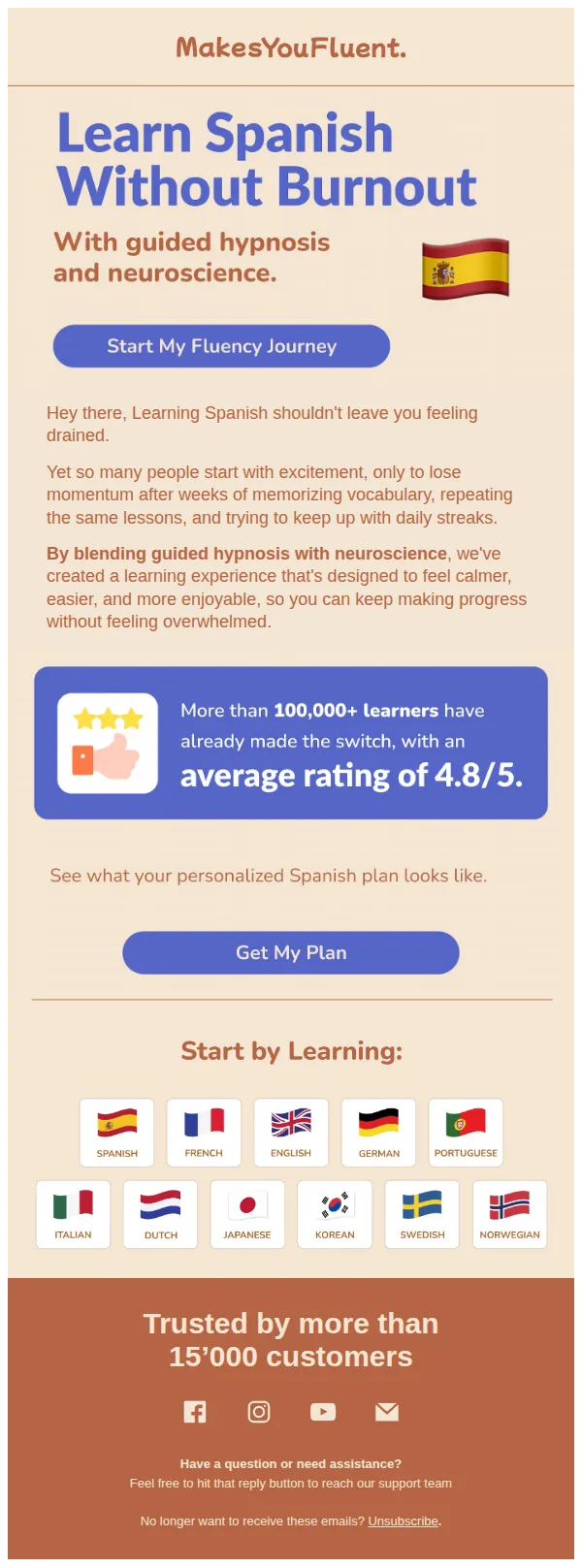
- 01You Don't Have to Burnout to Become Fluent
- 02"The report was really insightful"
- 03Still working on your window covering project? We've got just the treat for you!
- 04We weren't planning to do this
- 05Your wardrobe isn’t working (here’s why)
- 06Your Raising Dog book #RDNA000Y will be deleted tonight
Questions marketers ask.
What makes a good abandoned cart email?
What hook types do brands use for abandoned cart emails?
Which ESPs do brands use to send abandoned cart emails?
What's the average subject line length for abandoned cart emails?
Where can I see more abandoned cart email examples?
600+ brands. 20,000+ classified emails.
Inside the vault.
Filter by hook, framework, ESP, funnel stage — search every send. $19/mo. Cancel anytime.
Browse the vault — free