Re-engagement Email Examples — how brands wake up dormant subscribers
Every re-engagement send from every brand we track. Hooks, timing, offer mechanics — on the record.
Re-engagement sits between win-back (lapsed user) and lifecycle nurture (active user). It targets subscribers who stopped opening — not customers who stopped paying. The collection below pulls every re-engagement email indexed in the BadRep vault, classified across 20+ dimensions.
What brands actually do.
Most-used hook types
- 01Problem37%
- 02Bold Claim25%
- 03Question15%
- 04Curiosity7%
- 05Quote5%
Most-used copy frameworks
- 01PAS45%
- 02Story-led19%
- 03Other17%
- 04BAB14%
- 05AIDA3%
4 rules for re-engagement emails that convert.
What actually works — pulled from analyzing real send data, not from generic copywriting blog posts.
Trigger on engagement, not on purchase
Re-engagement is for subscribers who stopped opening, not subscribers who stopped buying. Trigger on open-rate decay (no opens in 30/60/90 days), not transaction recency.
Confirm permission explicitly
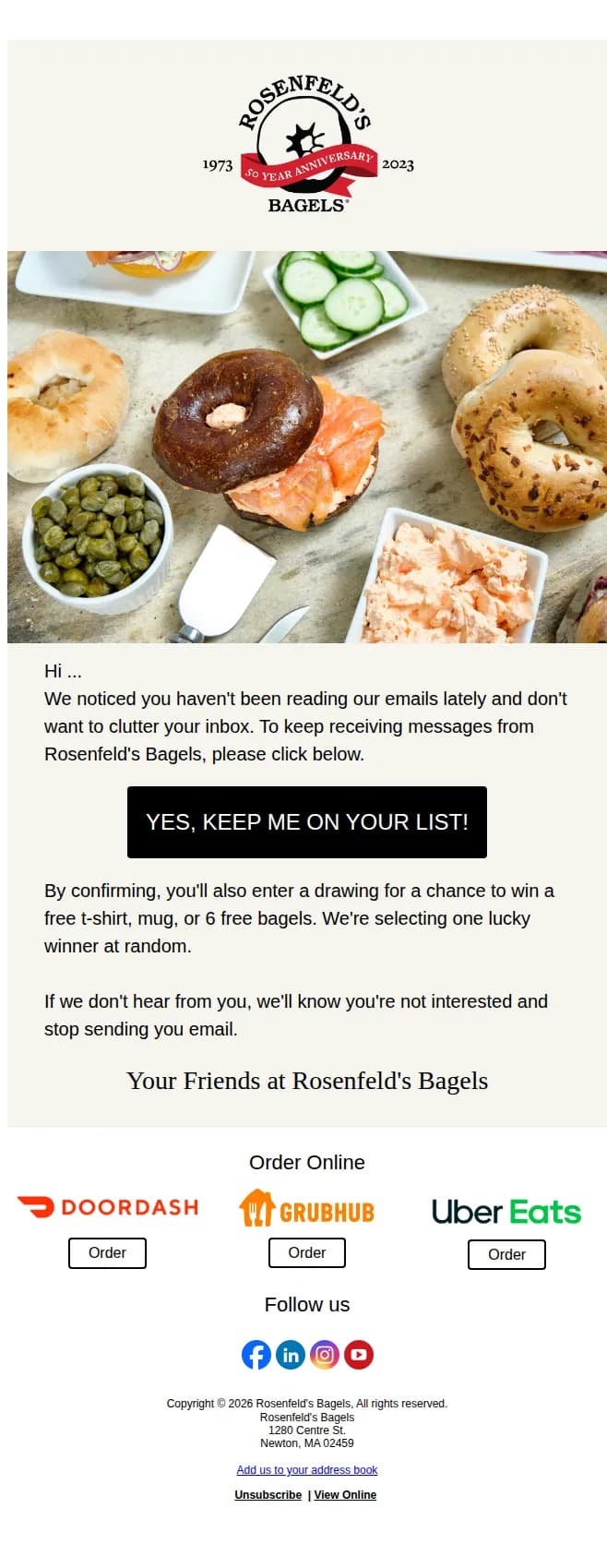
The strongest re-engagement sends include an explicit 'still want to hear from us?' button. Subscribers who click stay on the list as engaged. Subscribers who don't get cleaned out. Both outcomes improve deliverability.
Use the lapse as the hook
Subject lines like 'We noticed you've been quiet' or 'Did we lose you?' acknowledge the relationship. Generic 'newsletter' subject lines to dormant subscribers underperform sharply.
Cap the sequence at 2 sends
Re-engagement isn't win-back. Two sends — one nudge, one final 'last chance to stay' — is enough. Subscribers who don't respond should be moved to a sunset segment, not bombarded.
How to write a re-engagement email — step by step.
- Step 01
Define dormant
Open rate decay over a defined window. 30, 60, or 90 days without opens is the standard threshold.
- Step 02
Open with the relationship, not the brand
Acknowledge the time gap. 'It's been a while' is more honest than 'Check out what's new.'
- Step 03
Make the confirmation explicit
Single button: 'Yes, keep me subscribed.' Click = stay. No click = cleanup.
- Step 04
Sunset clearly
After two failed re-engagement sends, remove. Tell the subscriber explicitly: 'We won't email you again unless you re-subscribe.'
The latest re-engagement from across the catalog.
Real sends, recent dates, real subject lines. Click any thumbnail to see the full email inside the vault.


Mistakes brands keep making with re-engagement emails.
The patterns we see repeatedly across the catalog — the ones that quietly cap performance.
Not removing non-responders
After re-engagement fails, dormant subscribers should be removed from your main list. Keeping them dilutes your engagement metrics and damages deliverability.
Treating re-engagement like win-back
Win-back targets lapsed customers (didn't buy). Re-engagement targets dormant subscribers (didn't open). The hooks are different.
Sending the same nurture to dormant and active
Active subscribers get one cadence. Dormant subscribers need a different cadence — usually less frequent, with engagement-conscious content.
Subject lines we noticed, verbatim.
Six standout subject lines from six different brands in this sample. Real subject lines — these landed in inboxes.
- 01One click, —or you’ll miss all the fun!
- 02Your updated weight loss score: 6.4/10 — your plan will be deleted in 2 days ⏳
- 03Training check in
- 0424h left to claim your discount
- 05✨ Your coach is waiting
- 06💋 Roxy's feelings just slipped out. Emilia is in deeper than she thought.
Questions marketers ask.
What makes a good re-engagement email?
What hook types do brands use for re-engagement emails?
Which ESPs do brands use to send re-engagement emails?
What's the average subject line length for re-engagement emails?
Where can I see more re-engagement email examples?
600+ brands. 20,000+ classified emails.
Inside the vault.
Filter by hook, framework, ESP, funnel stage — search every send. $19/mo. Cancel anytime.
Browse the vault — free