Mental Health Re-engagement Email Examples — how mental health brands wake up dormant subscribers
Every re-engagement send from every mental health brand we track. Hooks, timing — on the record.
Dormancy windows are niche-specific. The collection below pulls every re-engagement email from mental health brands in the BadRep vault, classified across 20+ dimensions.
What works for mental health re-engagements.
The DB-derived patterns — what mental health brands consistently do in their re-engagement emails that you can replicate today.
Mental Health brands lean on "Question" hooks
37% of re-engagement emails in this niche open with a question hook. That's the dominant opening pattern — if you're writing your first re-engagement for mental health, that's the safest starting point.
Copy framework: "Other" dominates
41% of these emails structure their body using the Other framework. That tells you something about how the niche thinks about the subscriber's journey — and where you should reach for first.
Customer.io is the dominant ESP
44% of re-engagement sends in Mental Health flow through Customer.io. If you're picking infrastructure, that's the category default. Read the BadRep deep-dive on Customer.io to see what makes it the fit.
Subject lines average 41 characters
Tight subject lines preview cleanly on mobile. 22% of mental health re-engagement sends include emoji; 63% show personalization signals. Benchmark your own sends against these baselines.
What brands in this niche actually do.
Most-used hook types
- 01Question37%
- 02Problem30%
- 03Bold Claim26%
- 04Curiosity4%
- 05Direct Offer4%
Most-used copy frameworks
- 01Other41%
- 02PAS26%
- 03Story-led22%
- 04BAB7%
- 05FAB4%
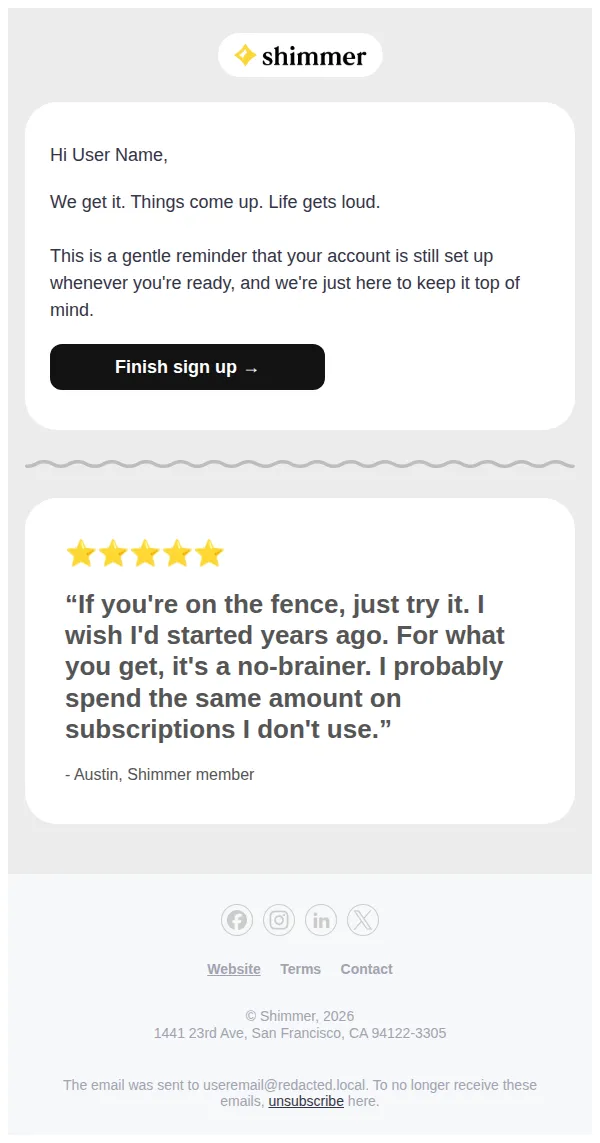
Real re-engagement from mental health brands.
Subscribers see them in full — every screenshot, raw HTML, full classification.


Subject lines we noticed, verbatim.
Six standout subject lines from this segment. Real subject lines — these landed in inboxes.
- 01✨ Your coach is waiting
- 02the BBC just covered this (and it's not what you'd expect)
- 03Can you help me?
- 04Наша підтримка чекає на вас
- 05Не сподобався перший терапевт? Все гаразд, маємо вирішення.
- 06Write down your thoughts and achievements for Today | June 27, 2026
Want to write a re-engagement for your own mental health brand?
The examples above show what other brands send. The methodology — the step-by-step on how to structure your own re-engagement, the framework choices, the sequence timing, the mistakes to avoid — lives on the parent hub.
Read the full re-engagement email guide →Related examples by niche + tactic.
Questions marketers ask.
What makes a good Mental Health re-engagement email?
What hook types do Mental Health brands use in re-engagement emails?
What ESPs do Mental Health brands use?
How often do Mental Health brands send re-engagement emails?
Where can I see more Mental Health re-engagement examples?
Every re-engagement email from every mental health we track.
Inside the vault.
Filter by hook, framework, ESP, funnel stage — search every send. $19/mo. Cancel anytime.
Browse this niche — free preview