Win-back Email Examples — how brands re-engage lapsed subscribers
Every win-back send from every brand we track. Subject lines, hooks, offer mechanics — on the record.
Win-back is the most under-resourced automation in most programs — and the highest-ROI when it works. The lapse window matters (30 vs 60 vs 90 days). The hook matters (discount vs new feature vs survey). The cadence matters (single send vs three-part sequence). The collection below pulls every win-back email indexed in the BadRep vault, classified by hook type, copy framework, ESP, and offer mechanic. We surface what brands actually send.
What brands actually do.
Most-used hook types
- 01Bold Claim33%
- 02Problem31%
- 03Direct Offer10%
- 04Story9%
- 05Question9%
Most-used copy frameworks
- 01PAS38%
- 02BAB28%
- 03Story-led16%
- 04FAB8%
- 05Other4%
6 rules for win-back emails that convert.
What actually works — pulled from analyzing real send data, not from generic copywriting blog posts.
Define the lapse window before you write a word
A 'lapsed' subscriber means different things at different brands. For DTC apparel, 90 days. For wellness apps, 30. For B2B SaaS, anywhere from 14 to 60. The strongest win-back programs define this explicitly based on average purchase or usage cycle, then trigger the sequence at that exact threshold.
Reference the relationship, not the absence
Subject lines like 'we miss you' read as needy and underperform. The strongest open with what changed since the subscriber last engaged — new features, restocked items, a meaningful update. 'It's been a while since you tried X' beats 'Come back!' every time.
Don't lead with a discount
Just like abandoned cart, leading the win-back with a discount trains subscribers to lapse on purpose. The strongest sequences open with the why (new product, restocked size, fresh content) and only escalate to an incentive on send two or three.
Make the unsubscribe path obvious
Counterintuitive but true: the strongest win-back sequences include an explicit 'or unsubscribe — no hard feelings' line. This filters out subscribers who weren't going to convert anyway and improves deliverability for the rest. Engaged lists beat large lists every single time.
Use a 3-step sequence over 14–21 days
Single-send win-backs leave money on the table. Three-step sequences pushed out over 2–3 weeks let multiple hooks land. The pattern: day 1 (re-introduction), day 7 (social proof or new feature), day 14 (offer if needed and final 'last call').
Survey-led win-back works for high-AOV products
For premium or considered purchases, a survey-led win-back ('what made you stop?') outperforms an offer-led one. The data goes into your product team. The subscriber feels heard. The conversion happens on the back of that conversation rather than a discount.
How to write a win-back email — step by step.
- Step 01
Define what 'lapsed' means for your brand
Look at average purchase cycle, login frequency, or last-open date. Pick a threshold (30, 60, 90, 180 days). That's your lapse window. The win-back sequence triggers when a subscriber crosses it.
- Step 02
Segment by lapse window severity
30-day lapsers get a soft 'check this out' send. 90-day lapsers get a stronger 'here's what changed.' 180-day lapsers get an offer-led 'last chance.' One sequence, three branches, written for the actual lapse stage.
- Step 03
Open with what changed
Subscribers lapsed because the value didn't compound. The strongest opening line names what's different now — new product, new content, new feature. 'Since you've been gone, X happened' beats 'We miss you' every time.
- Step 04
Make the path to re-engagement frictionless
One-click 'pick up where you left off.' One-click 'view what's new.' One-click access. Friction kills re-engagement faster than any other variable.
- Step 05
Add the unsubscribe option explicitly
'Or if this isn't for you anymore, no hard feelings — unsubscribe here.' This filters self-selected churners out of your list, improving the engagement score for everyone else.
- Step 06
Track what worked and refine
Win-back is the easiest sequence to A/B test because there's no urgency — you can wait three months between tests. Track conversion by hook type and offer mechanic over a full year. The findings compound into a much stronger program.
What a win-back sequence actually looks like.
- 01
Send 1 — Day 1 (re-introduction)
Open with what's new since they lapsed. No offer. Subject line: 'Since you've been gone…' or 'Quick update from {Brand}.'
- 02
Send 2 — Day 7 (social proof)
Show what other subscribers are doing — new arrivals, latest reviews, recent activity. Still no offer. Subject line: 'Here's what's resonating right now.'
- 03
Send 3 — Day 14 (final offer + unsub option)
If they still haven't engaged, send an offer paired with an explicit unsubscribe option. Subject line: 'A nudge — or no hard feelings.'
The latest win-back from across the catalog.
Real sends, recent dates, real subject lines. Click any thumbnail to see the full email inside the vault.


Mistakes brands keep making with win-back emails.
The patterns we see repeatedly across the catalog — the ones that quietly cap performance.
Treating all lapsers the same
A subscriber who lapsed at 30 days needs different copy than one who lapsed at 180 days. The strongest programs route lapse window into segment and adjust hooks accordingly. Generic 'where you been' messaging underperforms badly.
Sending the same offer your active customers see
If your active list sees 15% off codes weekly, a 15% win-back offer is invisible. The strongest win-back offers are either larger than usual ('25% off — for you specifically') or fundamentally different (early access, exclusive bundle).
Stopping the program at one send
Most programs have a single 'we miss you' send and call it done. The biggest win-back gains we've seen come from extending the sequence to three sends across 2–3 weeks.
Not removing post-conversion
If a subscriber re-engages on send one, they shouldn't get send two and three. This sounds obvious but the suppression logic frequently breaks in lifecycle programs, sending the same person every step of the sequence even after they came back.
Sending win-back to people who churned for cause
If a subscriber explicitly unsubscribed or filed a CX complaint, don't include them in win-back. Lifecycle data drift means programs frequently re-target unhappy customers, which damages brand trust and sometimes triggers spam complaints.
Subject lines we noticed, verbatim.
Six standout subject lines from six different brands in this sample. Real subject lines — these landed in inboxes.
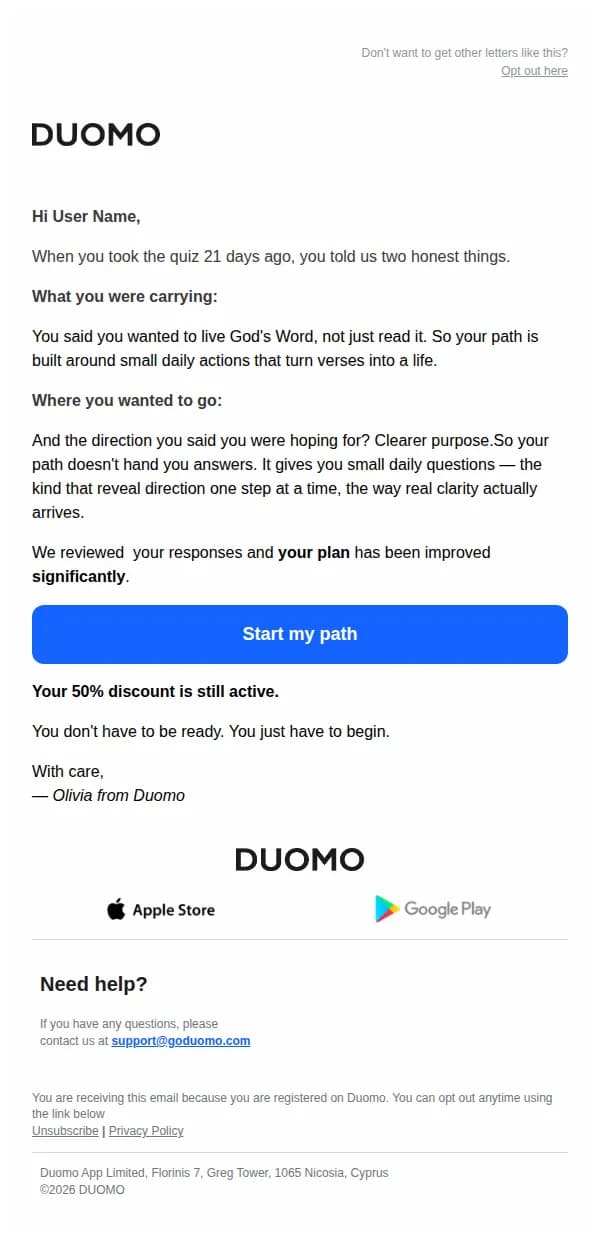
- 01Your path was built for exactly this
- 02Build habits that last—and get 8 months free 💛
- 03Get back to health with WalkFit
- 04Don’t Miss Out on 30 Days of Free Classes – Join Now!
- 05it's me. don't tell anyone.
- 06😢 We're saying goodbye (but here's one last gift)
Questions marketers ask.
What makes a good win-back email?
What hook types do brands use for win-back emails?
Which ESPs do brands use to send win-back emails?
What's the average subject line length for win-back emails?
Where can I see more win-back email examples?
600+ brands. 20,000+ classified emails.
Inside the vault.
Filter by hook, framework, ESP, funnel stage — search every send. $19/mo. Cancel anytime.
Browse the vault — free